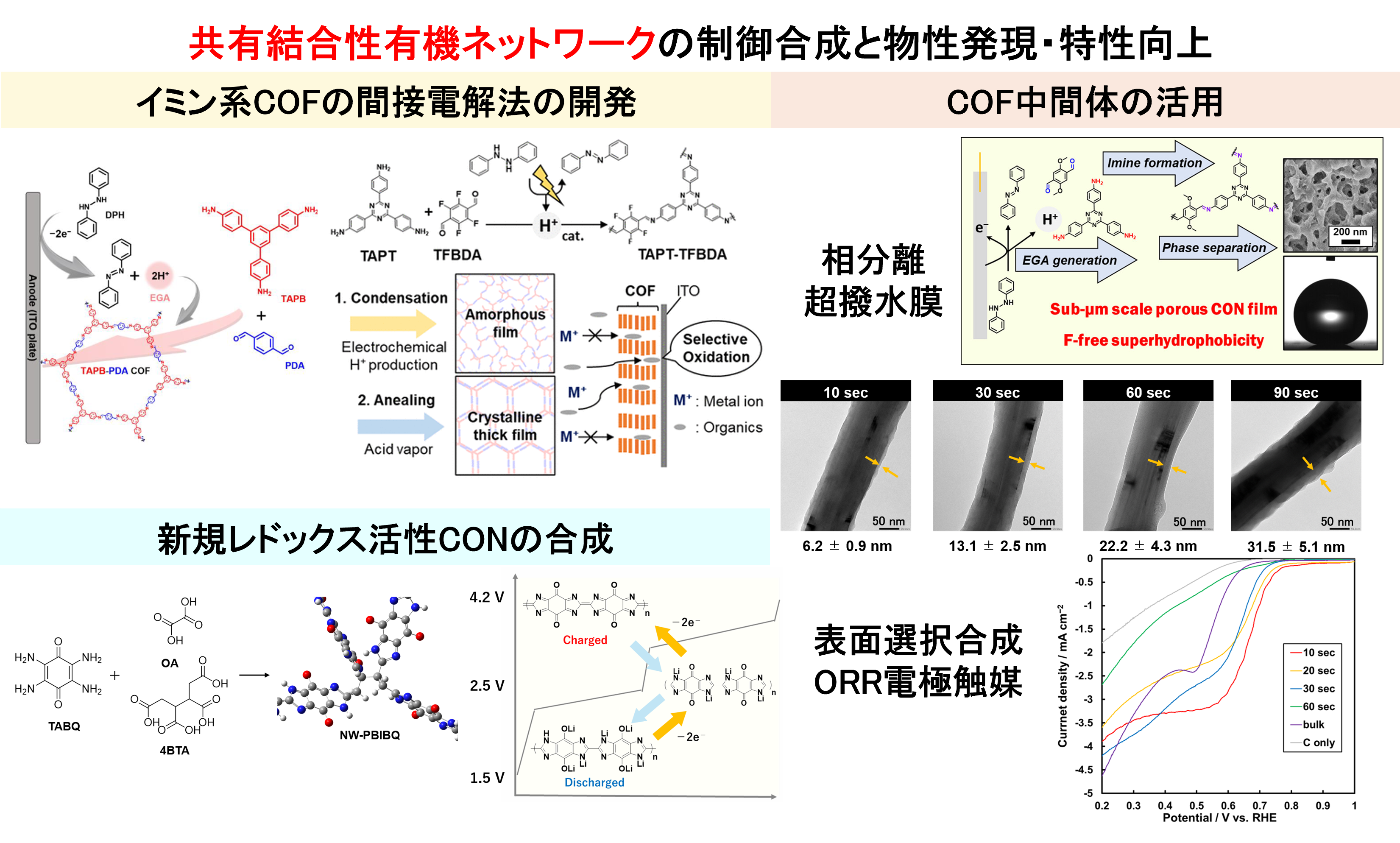
Through the synthesis and structural control of covalent organic networks (CONs), we explore novel functionalities derived from their porosity and electronic structure. Focusing on liquid-phase and electrochemical synthesis, we investigate the relationship between their higher-order structure and their properties.
Highly cross-linked network polymers can adopt a wide range of higher-order structures, from completely amorphous random networks to semi-ordered structures often composed of stacked two-dimensional layers, and ultimately to crystalline covalent organic frameworks (COFs). These structural variations strongly influence their physical and chemical properties. Owing to their densely cross-linked architectures, these materials are insoluble, infusible, and exceptionally robust for organic materials. They also exhibit unique functionalities arising from their structural porosity and semiconductor-like electronic structures. To date, we have successfully developed liquid-phase synthetic methods for two-dimensional network polymers incorporating abundant heterocyclic units, as well as an indirect electrochemical synthesis method for COFs. Building on these distinctive synthetic approaches, we aim to develop novel network materials with unprecedented properties and functionalities.
Last updated: