Research overview
We focus on solid polymeric materials with electrical or optical functionalities, aiming to develop new physical properties or enhance existing ones through the design of molecular structures and the control of morphology during synthesis. Our research centers, in particular, on applications in electrochemical energy conversion and the development of thin-film materials, where properties are heavily influenced by porosity and morphology. In our work, we actively incorporate quantum chemical calculations of organic molecules as well as methods from information science—such as materials informatics and process informatics—to analyze structure-property relationships, understand morphological formation processes, and facilitate both the efficient, broad-scale exploration of materials and the development of domain-specific predictive techniques.
- Conjugated polymer materials
- Electrochemistry
- Informatics
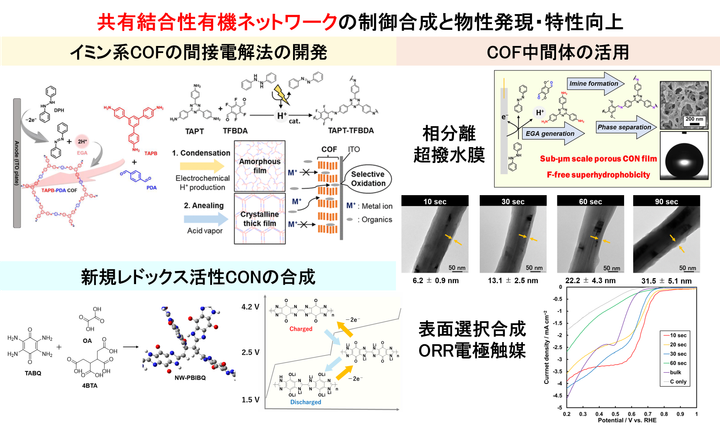
Synthesis and application of covalent organic network materials
Through the synthesis and structural control of covalent organic networks (CONs), we explore novel functionalities derived from their porosity and electronic structure. Focusing on liquid-phase and electrochemical synthesis, we investigate the relationship between their higher-order structure and their properties.
Read more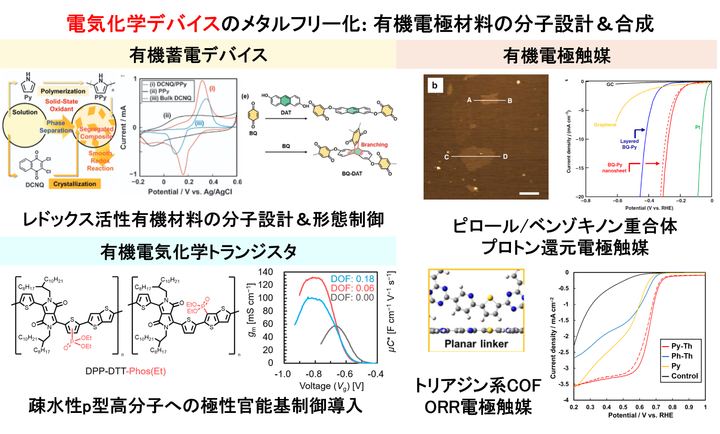
Developments of organic electrode materials
Developing sustainable organic electrode materials with functionalities, focusing on molecular design and the control of nanostructures: by targeting redox-active polymers and covalent organic frameworks, we have studied their applications in batteries, electrocatalysis, and organic transistors
Read more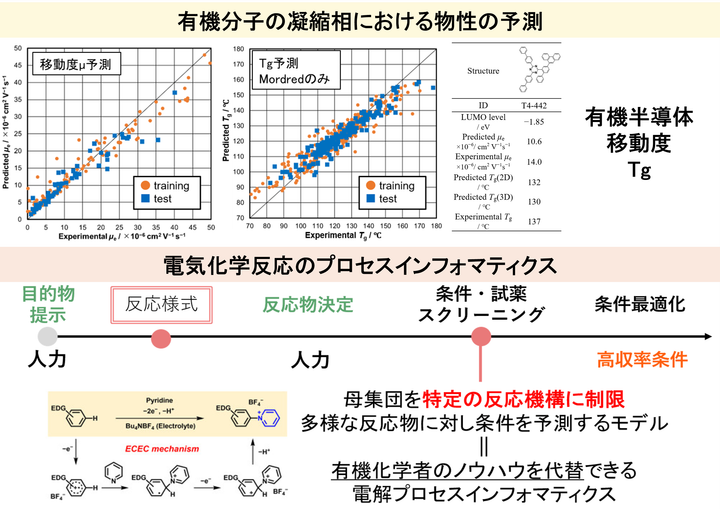
Materials and process informatics
We combine experimentation with data science in researches of polymer materials and electrochemical processes. Our goal is to efficiently explore unknown domains while developing predictive techniques for specific areas, grounded in physical and chemical insights.
Read more