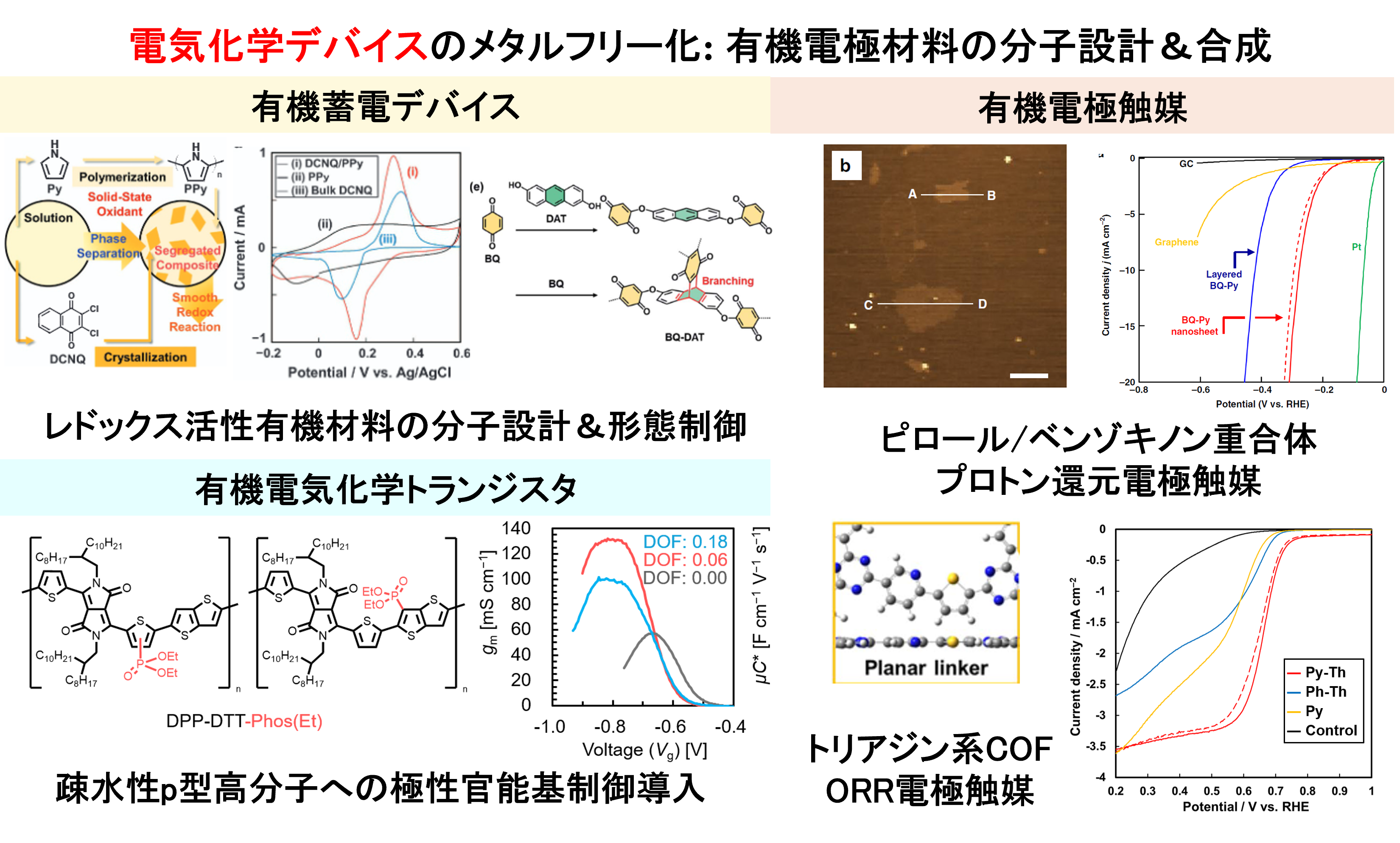
Developing sustainable organic electrode materials with functionalities, focusing on molecular design and the control of nanostructures: by targeting redox-active polymers and covalent organic frameworks, we have studied their applications in batteries, electrocatalysis, and organic transistors
Electrochemical technologies underpin a wide range of modern industrial applications, from energy conversion devices such as batteries and water electrolysis systems to chemical sensing. In recent years, growing attention has been directed toward replacing key components of electrochemical devices with organic materials. Representative examples include organic batteries utilizing redox-active molecules capable of repeated oxidation and reduction, organic electrocatalysts incorporating heteroaromatic units with unique electronic structures, and organic electrochemical transistors. To date, we have reported the development of metal-free oxygen reduction electrocatalysts based on covalent organic frameworks (COFs), as well as the synthesis of novel redox-active polymers and their applications in rechargeable batteries. Building on molecular design and nanostructural control, we aim to develop advanced functional organic electrode materials with novel electrochemical properties and functionalities.
Last updated: